

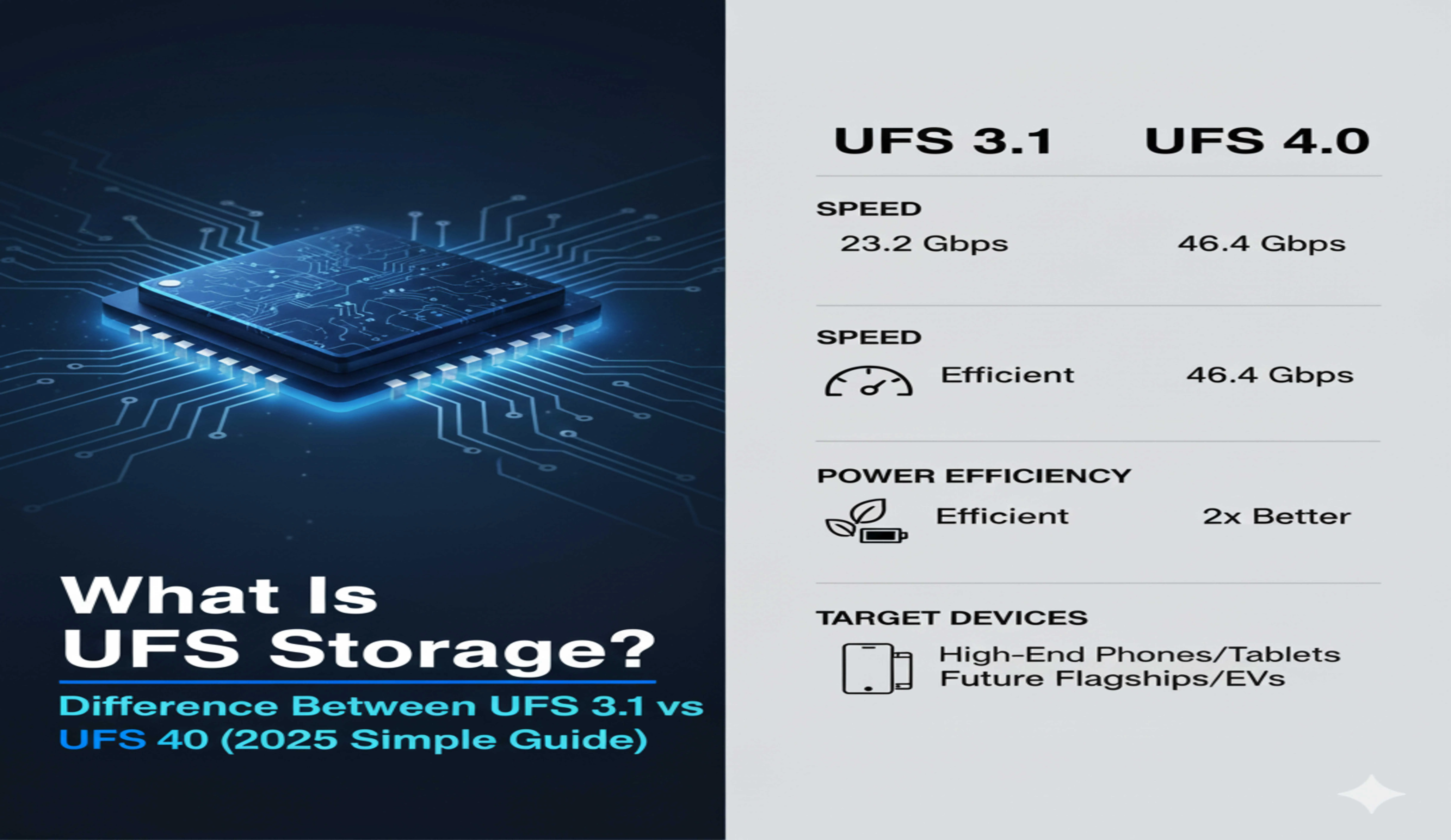
What Is UFS Storage? UFS 3.1 vs UFS 4.0 (2025 Guide)
UFS storage is the high-speed internal storage used in modern smartphones, offering faster read/write speeds and better efficiency compared to older technologies. In 2025, most mid-range and flagship smartphones use either UFS 3.1 or the newer UFS 4.0. Understanding the difference between UFS 3.1 vs UFS 4.0 helps you know how fast your phone performs in app loading, gaming, file transfers, and multitasking. In this guide, we’ll explain what UFS storage means, how it works, and which version is better for you.
Table of Contents
- What Is UFS Storage?
- How UFS Storage Works
- UFS vs eMMC – Why UFS Is Better
- What Is UFS 3.1?
- What Is UFS 4.0?
- Full Comparison: UFS 3.1 vs UFS 4.0
- Real-World Differences You’ll Notice
- Which One Should You Choose?
- Future of UFS Storage (2025 & Beyond)
What Is UFS Storage?
UFS (Universal Flash Storage) is a fast and efficient type of internal storage used in smartphones, tablets, wearables, and other compact devices. It is designed to handle large files, quick data transfers, and heavy apps without slowing down the device.
Compared to the older eMMC storage, UFS provides:
- Much faster read/write speeds
- Lower power consumption
- Better multitasking
- Improved reliability
Today, UFS has become the standard for Android phones.
How UFS Storage Works
UFS uses a technology called full-duplex communication, meaning it can read and write data at the same time. This is similar to how SSDs work on laptops and PCs. Because of this, UFS provides:
- Faster app loading
- Smoother gaming
- Quicker file transfers
- Better performance under heavy usage
Modern UFS versions also use NAND flash technology that improves speed and lifespan.
UFS vs eMMC – Why UFS Is Better
Before UFS, smartphones used eMMC storage, which was significantly slower.
Major differences:
- eMMC can only read or write at once (half-duplex)
- UFS can read + write simultaneously (full-duplex)
- UFS has much higher bandwidth
- UFS improves app responsiveness
Speed comparison:
- eMMC: 100–250 MB/s
- UFS 3.1: up to 2100 MB/s
- UFS 4.0: up to 4200 MB/s
The jump from eMMC to UFS was similar to the jump from HDD to SSD in computers.
What Is UFS 3.1?
UFS 3.1, launched in 2020, became the most popular storage standard in smartphones from 2021 to 2023. Many phones in 2025 still use UFS 3.1 in mid-range and budget flagship devices.
Key features:
- Up to 2100 MB/s read speed
- Up to 1200 MB/s write speed
- Improved power efficiency
- Thermal throttling control
- Deep Sleep mode for better battery life
It offers great performance but falls behind the newer UFS 4.0 standard.
What Is UFS 4.0?
UFS 4.0, introduced by Samsung in 2022, is a massive upgrade and the fastest storage available in modern flagship smartphones.
Key features:
- Up to 4200 MB/s read speed (2× UFS 3.1)
- Up to 2800 MB/s write speed
- 46% better power efficiency
- Compact and lightweight module
- Improved data longevity
UFS 4.0 is now standard in high-end phones like Samsung Galaxy S series, iQOO, OnePlus, and ASUS ROG devices.
Full Comparison: UFS 3.1 vs UFS 4.0
| Feature | UFS 3.1 | UFS 4.0 |
|---|---|---|
| Read Speed | Up to 2100 MB/s | Up to 4200 MB/s |
| Write Speed | Up to 1200 MB/s | Up to 2800 MB/s |
| Power Efficiency | Good | 46% better |
| App Loading Time | Fast | Much faster |
| File Transfer | Quick | 2× quicker |
| Gaming | Smooth | More stable under load |
| Heat Management | Average | Superior |
| Best For | Mid-range devices | Flagships & gaming phones |
Real-World Differences You’ll Notice
Here’s how UFS 4.0 improves your real-life mobile experience compared to UFS 3.1:
- Apps open almost instantly
- Zero lag when switching multiple apps
- Large games like BGMI, CODM, Genshin load faster
- Videos and photos process quicker
- Better performance in 4K/8K video recording
- Lower battery drain during heavy tasks
If you use your phone heavily, you will feel the difference clearly.
Which One Should You Choose?
If you want the best performance in 2025, choose:
- UFS 4.0 → For gaming, heavy apps, flagships
- UFS 3.1 → For budget and mid-range phones
UFS 4.0 gives double the performance and better efficiency, but UFS 3.1 still offers excellent value for money.
Future of UFS Storage (2025 & Beyond)
The next-generation standard UFS 5.0 is expected to arrive soon with even higher speed and efficiency. As smartphones keep getting faster processors and higher camera resolutions, storage improvements will play a big role in overall performance.
For now, UFS 4.0 remains the gold standard in mobile storage.
Conclusion
UFS storage plays a major role in smartphone speed and responsiveness. While UFS 3.1 is still great for mid-range phones, UFS 4.0 delivers flagship-level performance with double the speed, better power efficiency, and better multitasking. If you’re buying a phone in 2025 and want the fastest experience, choose a device with UFS 4.0.